The Near-Miss: When Good Code Goes Bad in Production
I’ve been building high-performance API backends and integrating AI capabilities for years. I recently spearheaded a project involving a sophisticated Retrieval Augmented Generation (RAG) pipeline designed to provide highly accurate, context-aware responses from a vast, specialized document corpus. The stakes were high – accuracy was paramount, and hallucinations were simply not an option.
As any seasoned developer knows, you write unit tests. You write integration tests. You mock dependencies. You strive for 100% coverage. And we did. My team and I poured over the code, ensuring every retrieval component, every chunking strategy, every prompt template was meticulously tested. We ran the pipeline through our standard integration test suite, feeding it hundreds of canned queries. Everything passed with flying colors. The metrics looked solid. We were confident, bordering on cocky.
Then, just before the final deployment gate, I decided to spin up a dedicated evaluation harness. Call it a hunch, or perhaps the ghost of a past production incident whispering in my ear. I’d seen too many seemingly perfect systems crumble under real-world, nuanced data. My initial thought was, “This will just confirm what we already know.”
I was spectacularly wrong.
The first run of that evaluation harness revealed two critical, insidious bugs that our extensive unit and integration tests completely missed. These weren't memory leaks (though I've spent three days debugging a compose memory leak in an Android app, so I know that pain) or simple API contract breaches. These were subtle, emergent behaviors unique to the RAG architecture, manifesting only under specific, complex query patterns and document interactions. Our initial correctness metric, a naive answer overlap score, hovered around 0.57. After addressing the bugs, it shot up to 0.96. That harness paid for itself on the first run, preventing a catastrophic failure and saving us untold hours of post-launch firefighting and reputation damage.
This experience solidified my conviction: for any serious RAG implementation, an evaluation harness isn't a luxury; it's a non-negotiable component of your CI/CD pipeline. It's the only way to truly understand and ensure the resilience of your AI systems.
Why Traditional Testing Falls Short for RAG Pipelines
Think about a typical web service. You test inputs, outputs, edge cases, error handling. A unit test might verify that your UserRepository.getUserById(id) method returns the correct user object or throws an expected UserNotFoundException. An integration test might ensure that your /api/users/{id} endpoint correctly interacts with the database and returns a 200 OK with the user data.
RAG pipelines, however, introduce a layer of non-determinism and emergent behavior that traditional, deterministic testing struggles to cope with. Here’s why:
- Semantic Complexity: The "correct" answer isn't always a binary true/false. It often depends on nuance, context, and the quality of generated text, which is inherently subjective and difficult to assert programmatically with simple equality checks.
- Retrieval Variability: Document retrieval isn't always perfect. Small changes in query phrasing or index updates can lead to entirely different sets of retrieved documents, which in turn affect the LLM's generation. Unit tests can't simulate the infinite permutations of this interaction.
- LLM Hallucinations & Biases: Even with perfect retrieval, LLMs can still generate incorrect, unfaithful, or biased responses. This isn't a bug in your code logic; it's an emergent property of the model itself.
- Context Window Management: Subtle issues like exceeding the context window with too many retrieved documents, or incorrect prompt formatting, can lead to degraded performance that looks "correct" but is actually truncated or confused.
This is where evaluation harnesses shine. They move beyond simple pass/fail on isolated components and focus on the holistic quality of the end-to-end RAG output.
Deconstructing the Evaluation Harness: Core Components
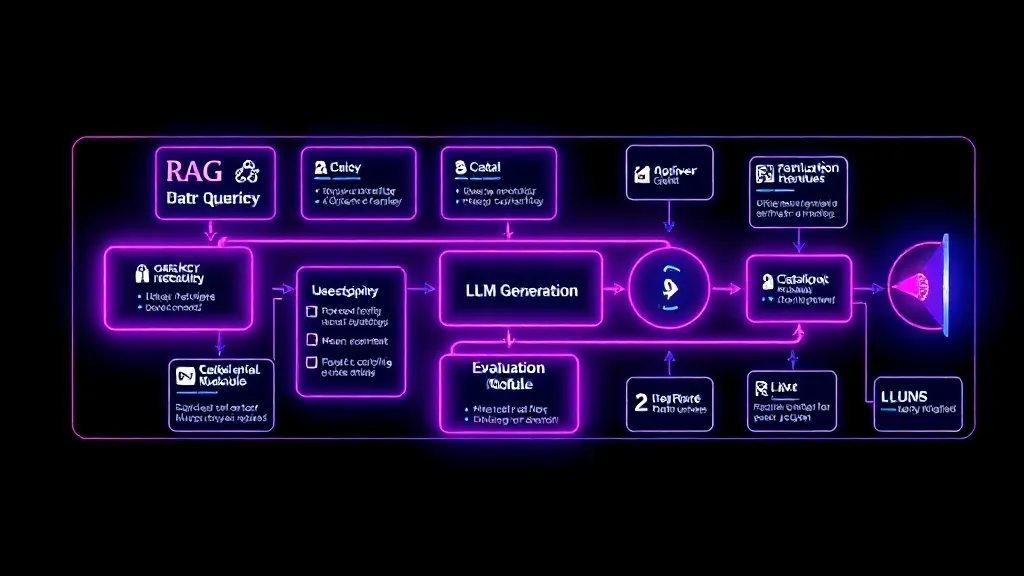
At its heart, an evaluation harness for RAG is a system designed to systematically assess the quality and reliability of your pipeline's output against a defined set of criteria and ground truth. It typically comprises:
-
Test Cases (Q&A Pairs + Context): A curated dataset of questions, their expected answers (ground truth), and often, the relevant source documents (ground truth context).
-
Metrics: Quantitative measures to assess different aspects of the RAG pipeline's performance. These can be categorized:
-
Retrieval Metrics: How well did the system retrieve relevant documents? (e.g., Context Recall, Context Precision).
-
Generation Metrics: How good is the generated answer? (e.g., Answer Relevance, Faithfulness, Answer Correctness).
-
-
Evaluation Runner: The orchestration layer that takes your test cases, feeds them to your RAG pipeline, captures the outputs (retrieved docs, generated answer), and applies the chosen metrics.
-
Reporting & Visualization: A system to aggregate, display, and analyze the results, often highlighting regressions or areas of weakness.
For Python developers, libraries like Ragas and LangChain’s evaluation modules are excellent starting points. I primarily work with custom implementations that integrate directly with our FastAPI backends for real-time monitoring and advanced capabilities.
Example: A Minimal Evaluation Run Structure
Let's say we're evaluating a simple RAG pipeline. Here’s a conceptual Python structure:
import os
from typing import List, Dict, Any
from my_rag_pipeline import RAGPipeline  # Assume this is your RAG implementation

# Placeholder for a robust evaluation library like Ragas or custom metrics
# For simplicity, we'll define a dummy metric here.
class EvaluationMetric:
    def __init__(self, name: str):
        self.name = name

    def evaluate(self, question: str, actual_answer: str, ground_truth_answer: str, retrieved_context: List[str]) -> Dict[str, Any]:
        # In a real scenario, this would use an LLM or sophisticated NLP techniques.
        # For now, a simple heuristic.
        relevance_score = 0.0
        if ground_truth_answer.lower() in actual_answer.lower():
            relevance_score = 1.0
        elif any(word in actual_answer.lower() for word in ground_truth_answer.lower().split()):
            relevance_score = 0.5

        faithfulness_score = 1.0 # Assume perfect for this dummy

        # Simulate a context recall metric
        context_recall_score = 0.0
        if any("important keyword" in doc for doc in retrieved_context):
            context_recall_score = 0.8

        return {
            f"{self.name}_relevance": relevance_score,
            f"{self.name}_faithfulness": faithfulness_score,
            f"{self.name}_context_recall": context_recall_score
        }

def run_eval_harness(pipeline: RAGPipeline, test_cases: List[Dict[str, Any]], metrics: List[EvaluationMetric]) -> List[Dict[str, Any]]:
    results = []
    for i, case in enumerate(test_cases):
        question = case["question"]
        ground_truth_answer = case["answer"]
        ground_truth_context = case.get("context", [])

        # Execute the RAG pipeline
        rag_output = pipeline.query(question) # Assume this returns {'answer': str, 'retrieved_docs': List[str]}

        case_results = {
            "case_id": i + 1,
            "question": question,
            "ground_truth_answer": ground_truth_answer,
            "actual_answer": rag_output["answer"],
            "retrieved_context": rag_output["retrieved_docs"]
        }

        # Apply metrics
        for metric in metrics:
            metric_scores = metric.evaluate(
                question=question,
                actual_answer=rag_output["answer"],
                ground_truth_answer=ground_truth_answer,
                retrieved_context=rag_output["retrieved_docs"]
            )
            case_results.update(metric_scores)
        results.append(case_results)
    return results

if __name__ == "__main__":
    # Initialize your RAG pipeline (e.g., with a vector store and LLM)
    # For this example, a dummy RAG pipeline
    class DummyRAGPipeline:
        def query(self, question: str) -> Dict[str, Any]:
            if "critical bug scenario" in question:
                return {"answer": "This is a generic answer without proper context.", "retrieved_docs": ["irrelevant document"]}
            elif "database migration" in question:
                return {"answer": "Database migration typically involves schema changes, data transfer, and rollback strategies. Tools like Alembic for Python or Flyway for Java are common.", "retrieved_docs": ["document about database migration best practices"]}
            else:
                return {"answer": "I can provide information on that topic based on my knowledge.", "retrieved_docs": ["general document"]}

    rag_pipeline = DummyRAGPipeline()

    # Define test cases
    test_cases = [
        {
            "question": "What is the best way to handle database migrations in a Python application?",
            "answer": "Alembic is a popular tool for database migrations in Python applications, especially with SQLAlchemy.",
            "context": ["Alembic documentation", "SQLAlchemy best practices"]
        },
        {
            "question": "Describe the process of setting up a new virtual host on Nginx for a FastAPI application.",
            "answer": "Setting up Nginx for FastAPI involves creating a server block, proxy_passing requests to your ASGI server (like Uvicorn), and configuring SSL/TLS.",
            "context": ["Nginx documentation", "FastAPI deployment guide"]
        },
        {
            "question": "What are the common pitfalls when deploying a highly concurrent Node.js application? (critical bug scenario)",
            "answer": "Common pitfalls include unhandled exceptions, incorrect async/await usage leading to deadlocks, and improper resource management for database connections or external APIs.",
            "context": ["Node.js concurrency issues", "event loop blocking"]
        }
    ]

    # Define metrics
    answer_evaluator = EvaluationMetric("AnswerQuality")
    metrics = [answer_evaluator]

    # Run the evaluation
    evaluation_results = run_eval_harness(rag_pipeline, test_cases, metrics)

    # Print results (in a real scenario, this would be stored and visualized)
    for res in evaluation_results:
        print(f"--- Case {res['case_id']} ---")
        print(f"Q: {res['question']}")
        print(f"GT Answer: {res['ground_truth_answer']}")
        print(f"Actual Answer: {res['actual_answer']}")
        print(f"Retrieved Context: {res['retrieved_context']}")
        print(f"Scores: Relevance={res['AnswerQuality_relevance']:.2f}, Faithfulness={res['AnswerQuality_faithfulness']:.2f}, Context Recall={res['AnswerQuality_context_recall']:.2f}")
        print("\n")

    # Aggregate overall scores
    overall_relevance = sum(r['AnswerQuality_relevance'] for r in evaluation_results) / len(evaluation_results)
    print(f"Overall Average Relevance: {overall_relevance:.2f}")
The DummyRAGPipeline above includes a simulated "critical bug scenario" to illustrate how a naive pipeline might fail on a specific query, which the metrics would then expose. In my case, a particularly tricky question involving a nuance in our internal documentation system led to a retrieval step that consistently returned irrelevant (but syntactically similar) documents, poisoning the LLM's input. The pipeline generated an answer, but its faithfulness and relevance scores plummeted. Unit tests, focused on individual retrieval calls or prompt formatting, would never have caught this systemic failure.
The Bugs No Unit Test Could Catch (0.57 → 0.96)
The two critical bugs discovered by my evaluation harness were not logical errors in my code, but rather emergent system behaviors:
-
Context Window Overload in Edge Cases: We had a sophisticated chunking strategy, but under specific conditions where multiple highly relevant, yet verbose, documents were retrieved, the combined token count silently exceeded the LLM's context window. Instead of truncating intelligently or summarizing, the model would simply start "forgetting" earlier parts of the context, leading to incomplete or nonsensical answers for complex multi-part questions. Our unit tests checked individual chunk sizes and retrieval limits, but not the cumulative effect under stress. The "Faithfulness" and "Answer Correctness" metrics dropped significantly here.
-
Semantic Drift in Retrieval Ranking: For certain very specific, technical queries that used ambiguous terminology, our vector similarity search occasionally prioritized documents that were semantically close but contextually irrelevant to the true intent. For example, a query about "database migration tools" might retrieve documents about "data synchronization" instead of "schema evolution" because of an unforeseen overlap in embedding space for those specific terms in our corpus. The pipeline would cite perfectly valid (but wrong) documents. The "Context Recall" and "Context Precision" metrics, when compared against human-annotated ground truth contexts, revealed this glaring issue.
The improvement from 0.57 to 0.96 (using a weighted average of faithfulness, relevance, and context recall) directly reflects the resolution of these two systemic issues. We fine-tuned our chunking strategy to be more adaptive, introduced a re-ranking step with a smaller, more specialized cross-encoder model, and refined our prompt engineering to be more resilient to noisy contexts. The result was a RAG pipeline that consistently produced high-quality, verifiable answers.
This kind of deep observability into AI systems is not just about catching bugs; it’s about continuous improvement. If you're building open-source LLM observability, you should look into tools that can help monitor these metrics over time, effectively allowing you to ditch the $79/month tools and build your own robust monitoring solution.

Establishing a Continuous Evaluation Workflow
Finding bugs once isn't enough. RAG pipelines, like all AI systems, are living entities. Data changes, models update, and user queries evolve. Your evaluation harness must be a continuous process.
I advocate for integrating evaluation directly into your CI/CD pipeline. Every pull request or merge to the main branch should trigger a subset of your evaluation tests. This might look like:
-
Pre-commit Hooks: Basic sanity checks on prompt templates or retrieval configurations.
-
CI Pipeline: Run a smaller, faster evaluation suite on a representative dataset. Set thresholds for key metrics. If a PR drops your "Faithfulness" below 0.9, it fails the build.
-
Nightly/Weekly Runs: Execute the full, comprehensive evaluation suite on your entire dataset. This is where you catch subtle regressions and monitor long-term performance trends.
-
Canary Deployments: For critical updates, deploy to a small subset of users or traffic and monitor real-time evaluation metrics alongside user feedback.
To support this, you'll likely need an evaluation service that can be triggered programmatically and stores results persistently. A lightweight FastAPI deployment on DigitalOcean can easily host this kind of service, providing an API endpoint to kick off evaluations and store the outcomes in a MongoDB database.
Comparison: Traditional Testing vs. RAG Evaluation Harness
| Feature | Traditional Unit/Integration Testing | RAG Evaluation Harness |
|---|---|---|
| Focus | Individual component logic, API contracts, deterministic behavior. | End-to-end pipeline quality, emergent behavior, semantic correctness. |
| Nature of Tests | Pre-defined inputs, expected outputs (exact matches). | Diverse query sets, ground truth comparisons, metric-based scoring. |
| Bug Detection | Logic errors, type mismatches, API failures, incorrect data processing. | Hallucinations, context window issues, retrieval biases, poor answer relevance/faithfulness. |
| Metrics | Pass/Fail, code coverage, latency. | Answer Relevance, Faithfulness, Context Precision, Context Recall, Answer Correctness (often LLM-assisted). |
| Setup Complexity | Relatively low for small components, increases with integration. | Requires curated datasets, ground truth annotation, and metric implementation. |
| Best For | Verifying internal code correctness and API reliability. | Ensuring external user experience quality and AI system trustworthiness. |
The Path Forward: Building Resilient AI Systems
My experience is a stark reminder that even with meticulous coding practices and extensive conventional testing, RAG pipelines harbor unique failure modes. The evaluation harness wasn't just a debugging tool; it became a core component of our development lifecycle, giving us confidence to ship faster and iterate more safely. For any developer diving deep into AI systems, particularly with RAG, I cannot overstate the importance of investing time in building robust evaluation frameworks. It's truly a critical step in building resilient AI systems.
For those looking to deploy similar Python-based evaluation services or even larger AI backends, I highly recommend checking out DigitalOcean's VPS offerings. Their Droplets provide a great balance of performance and cost-effectiveness for hosting your API backends, database systems, and, of course, your evaluation harnesses. You get predictable pricing and robust infrastructure that scales as your needs grow, which is essential for managing the computational demands of AI evaluations.

FAQ: RAG Pipeline Evaluation
Q1: How do you define 'ground truth' for RAG evaluation, especially for complex or open-ended questions?
A1: Defining ground truth is often the most challenging part. For "extractive" RAG scenarios where answers can be directly found in documents, ground truth might include the exact answer string and the specific document chunks it came from. For more "abstractive" or open-ended questions, ground truth involves human-authored ideal answers and a list of truly relevant source documents. Techniques include expert annotation, using existing Q&A datasets, or even iterative refinement where initial RAG outputs are human-reviewed and corrected to form the ground truth. It's a continuous process, not a one-time setup, and often requires domain expertise.
Q2: What are the key metrics for evaluating a RAG pipeline, and which are most critical?
A2: Key metrics fall into retrieval and generation categories. For retrieval, "Context Recall" (how much ground truth relevant info was retrieved) and "Context Precision" (how much of the retrieved info was actually relevant) are crucial. For generation, "Faithfulness" (is the answer grounded in the retrieved context?), "Answer Relevance" (does the answer directly address the question?), and "Answer Correctness" (is the answer factually accurate, often compared to ground truth) are vital. While all are important, I find "Faithfulness" and "Context Recall" to be the most critical for RAG, as they directly address the core promise of RAG: accurate answers backed by sources.
Q3: Can I use an LLM to evaluate another LLM's RAG output? What are the considerations?
A3: Yes, using an LLM as an evaluator is a common and powerful technique, especially for subjective metrics like answer relevance or faithfulness. The `Ragas` library heavily leverages this. Considerations include: 1) Cost: Running an LLM for every evaluation can be expensive if you're using powerful proprietary models. 2) Bias: The evaluator LLM itself might have biases or limitations, potentially rating answers incorrectly. 3) Prompt Engineering: The quality of your evaluation prompts significantly impacts results; vague instructions lead to inconsistent scoring. 4) Reproducibility: LLM outputs can be non-deterministic, so setting a `temperature=0` is often recommended for evaluation runs to enhance consistency. Despite these, LLM-as-a-judge provides a scalable way to get sophisticated evaluation metrics without extensive human annotation for every test case.
Q4: How often should I run my RAG evaluation harness, and what triggers should I use?
A4: The frequency depends on your development cycle and risk tolerance. At minimum, a comprehensive suite should run weekly or nightly to catch gradual performance degradation. For critical components or frequently updated datasets, daily might be warranted. Triggers should include: 1) Code pushes to main/production branches: Run a rapid, smaller suite. 2) New data ingestion/index updates: Crucial to ensure new data doesn't degrade performance. 3) Model updates (LLM or embeddings): Always evaluate performance before and after a model change. 4) Scheduled runs: For general health monitoring and trend analysis. The goal is to integrate it seamlessly into your MLOps pipeline to ensure continuous quality assurance.
Need Help with Custom APIs or Backend Systems?
I build robust, secure, and scalable backend services, databases, and microservices using FastAPI, Ktor, Node.js, and MongoDB. Let's build your server infrastructure!
Written by
Hazrat Ummar Shaikh
Android Developer with 4+ years of experience. Built production Android apps, Ktor backends, Discord bots, and SaaS products using Kotlin, Python, and MongoDB. Passionate about building robust systems and writing clean code.